
The Day I Realized AI Was Actually Doing My Job
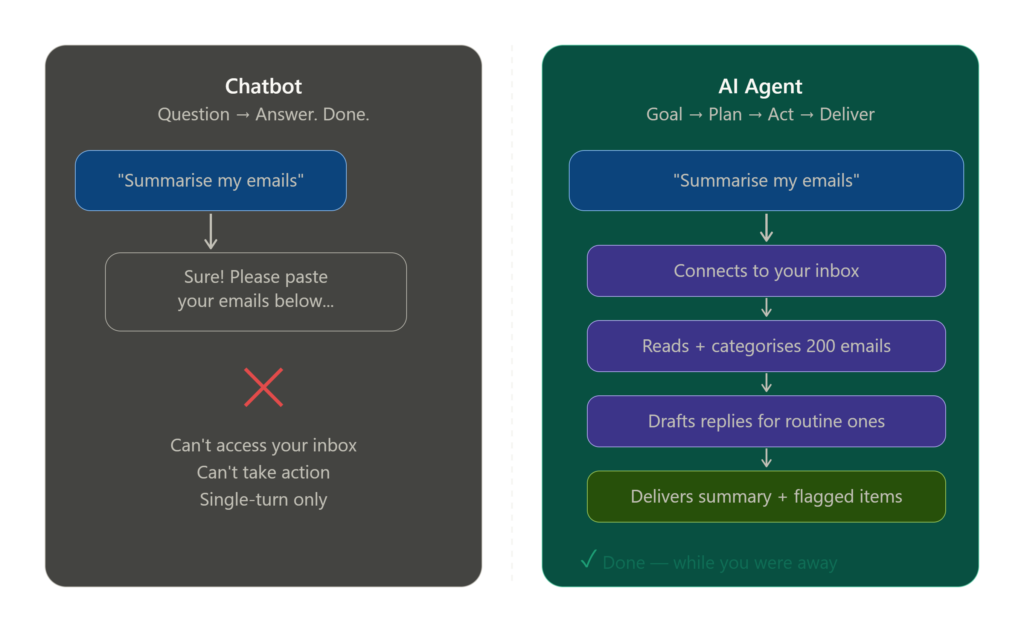
A few months back, I set up an AI agent to handle my email inbox while I was on a short trip.
I came back three days later expecting chaos — missed messages, confused clients, a disaster to clean up.
Instead? It had sorted 200+ emails, drafted replies to routine questions, flagged three urgent ones for me, and even updated my CRM with new lead details.
I genuinely sat there for a moment thinking, “Wait. Did I just become optional?”
That was the moment I stopped thinking of AI as a “helpful tool” and started seeing it for what it actually is: a worker that doesn’t sleep, doesn’t make excuses, and doesn’t need a coffee break.
AI agents are changing business in a very real, very measurable way — and if you’re not at least paying attention right now, you’re going to be playing catch-up sooner than you think.
What Are AI Agents, Really?
AI agents are software systems that can understand a goal, plan the steps to achieve it, take action across multiple tools and platforms, and learn from the results — all on their own.
That’s the key difference from regular AI tools like ChatGPT when you just chat with it.
When you type a question into ChatGPT, it answers. Done. It doesn’t go off and do anything.
An AI agent, on the other hand, is given a mission — not just a question. You might say: “Research our top 10 competitors, find gaps in their pricing pages, and create a report.” The agent then searches the web, pulls data, analyzes it, writes the report, and delivers it to you. No hand-holding required.
Think of it this way: regular AI is a calculator. AI agents are a junior employee.
How AI Agents Are Different from Chatbots
AI Agents vs Chatbots — The Key Differences
A lot of people still mix these up, and it’s understandable. They look similar on the surface.
Here’s a simple breakdown:
| Feature | Chatbot | AI Agent |
|---|---|---|
| Takes single instructions | ✅ Yes | ✅ Yes |
| Multi-step task execution | ❌ No | ✅ Yes |
| Connects to external tools/apps | ❌ Limited | ✅ Yes |
| Makes decisions independently | ❌ No | ✅ Yes |
| Can trigger actions (send email, update CRM) | ❌ No | ✅ Yes |
A chatbot answers your questions. An AI agent actually gets things done.
That’s why search interest in “AI agents” has jumped over 15% year-on-year in the US alone — while interest in “AI chatbot for business” has actually dropped nearly 40%. People aren’t looking for a conversation partner anymore. They want results.
How AI Agents Work — Without the Tech Jargon
The Inner Life of an AI Agent
Here’s how a typical AI agent actually operates, broken down into plain language:
Step 1 — You give it a goal Not a question. A mission. “Find me 20 potential leads in the UK SaaS market and add them to my spreadsheet.”
Step 2 — It builds a plan The agent figures out what tools and steps are needed. Maybe it’ll use a web search tool, a LinkedIn scraper, and your Google Sheets integration.
Step 3 — It takes action The agent actually goes out and does the work across multiple platforms simultaneously.
Step 4 — It checks itself Modern AI agents review their own outputs, notice errors, and correct them before handing results to you.
Step 5 — It reports back You get the finished output — in this case, a filled spreadsheet — and a summary of what it did.
The whole thing happens while you’re doing something else. That’s the magic.
Real Business Use Cases for AI Agents in 2026
Where AI Agents Are Making a Real Difference Right Now
I’ve personally tested or studied these use cases, and the results are genuinely impressive:
Customer Service Automation Companies like Danfoss are using AI agents to process email-based customer orders automatically — with 80% of transactions handled without any human input. Customer response time dropped from 42 hours to near-instant.
Lead Generation and Sales AI agents can monitor LinkedIn, find qualified leads based on your ideal customer profile, draft personalised outreach emails, and log everything in your CRM — all overnight, while you’re asleep.
Content and Marketing Workflows Marketing teams are deploying content agents that research trending topics, draft blog posts, schedule social media posts, and pull weekly analytics reports. One task that used to take a full day now takes about 20 minutes of human review.
Finance and Operations AI agents are now being used to reconcile invoices, flag payment anomalies, and generate spend reports — without anyone having to dig through spreadsheets manually.
IT and Cybersecurity Security teams are using agents to monitor systems 24/7, triage alerts, and escalate only the ones that actually need a human brain. The rest get handled automatically.
The common thread? These aren’t experiments anymore. These are production deployments with measurable ROI.
How to Get Started with AI Agents in Your Business
A Practical Step-by-Step Guide to AI Agents
You don’t need to be a developer or have a massive budget to start experimenting with AI agents. Here’s how to actually get going:
Step 1 — Pick one repetitive process Don’t try to automate everything at once. Pick the one task that eats the most time each week. Maybe it’s responding to customer FAQs, pulling weekly reports, or triaging your inbox.
Step 2 — Choose a beginner-friendly platform Some tools worth looking at in 2026:
- Relevance AI — great for building no-code AI agents
- Zapier Central — connects AI agents to thousands of apps
- n8n — open-source and very flexible for custom workflows
- Microsoft Copilot Studio — if you’re already in the Microsoft ecosystem
- Agentforce by Salesforce — built for sales and CRM automation
Step 3 — Define the goal clearly The more specific you are, the better the agent performs. Don’t say “help with emails.” Say “check incoming emails every 2 hours, categorise by urgency, and draft a reply for anything marked low-priority.”
Step 4 — Test with low stakes first Run it on a small batch. Check every output manually before going live. AI agents can make mistakes — especially early on.
Step 5 — Measure and adjust Track how much time it saves you, what errors it makes, and where it needs better instructions. Treat it like onboarding a new team member.
Common Mistakes People Make with AI Agents
What I Got Wrong (So You Don’t Have To)
Mistake #1 — Giving vague goals The first agent I ever built was told to “monitor my competitors.” It came back with a list of random companies from a different industry. Specificity matters enormously.
Mistake #2 — Skipping the testing phase I once let an agent send client emails before thoroughly reviewing its drafts. One message went out calling a client by the wrong first name. Not ideal.
Mistake #3 — Expecting perfection immediately AI agents aren’t plug-and-play. They need tuning. Plan for a two-to-four week learning curve before the output quality gets where you want it.
Mistake #4 — Automating a broken process If a workflow is messy when humans do it, an AI agent won’t fix the messiness — it’ll just do the messy thing faster. Clean up the process first, then automate.
Mistake #5 — No human checkpoint Even the best AI agents need a human to review high-stakes outputs. Keep a human in the loop for anything customer-facing or financially sensitive, at least to start.
The Future of AI Agents — What’s Coming Next
Where AI Agents Are Headed
Right now, most businesses are using single agents doing single jobs. But the next wave — already happening in larger enterprises — is multi-agent systems.
Imagine a team of AI agents working together: one researches, one writes, one schedules, one monitors performance, and one reports back to you. Each specialized agent handles its piece, then passes it off to the next. Like a digital assembly line.
Gartner predicts that 40% of enterprise applications will embed AI agents by the end of 2026 — up from less than 5% in 2025. The AI agents market is projected to grow from $7.8 billion today to over $52 billion by 2030.
That’s not hype. That’s where the money is going.
For small and medium businesses, the good news is that platforms like Relevance AI, n8n, and Zapier Central are making these capabilities accessible without needing a full engineering team.
The playing field is leveling fast. A two-person startup can now run with the operational efficiency of a team twice its size — if they know how to use AI agents well.
Final Thoughts
Look, I’m not going to tell you that AI agents will solve every problem in your business overnight. They won’t.
But I will say this — the businesses that are figuring this out right now, even imperfectly, are going to have a serious advantage over those who wait until it’s “more mature.”
AI agents aren’t a future technology. They’re here, they work, and they’re getting better every month.
Start small. Pick one process. Test it. Break it. Fix it. And then watch what happens when you have an AI agent handling the stuff that was eating your best hours every week.
That’s when it clicks. That’s when you start thinking about what you could actually do with all that time back.
For more information, visit: APKSITE1




The discussion in “What Are AI Agents? The Ultimate Guide to Powerful Business Automation in 2026 – APKSITE1.COM” is clear and useful. The supporting details make the main points much easier to understand.