
AI proposal writing service was not something I planned to get into. It happened by accident, on a random Tuesday night, when a friend messaged me in a panic asking if I could “make her business proposal sound less boring” before a client call the next morning.
I had never written a formal proposal in my life. But I had Claude open in another tab, and I figured, why not try.
Ninety minutes later, she had a five-page proposal that actually read like it was written by someone who understood her business. She landed the client. She paid me sixty dollars for what felt like barely any work. And that’s the night I realized there might be an actual business hiding inside this.
I want to walk you through everything I’ve learned since then, including the mistakes that cost me clients and the small habits that turned this into a repeatable freelance service.
What This Actually Is (In Plain English)
An AI proposal writing service means you help small businesses, freelancers, and consultants turn their rough ideas into polished, client-ready documents — proposals, pitch decks in written form, scopes of work, partnership pitches, grant applications, that kind of thing.
You’re not the expert in their industry. You don’t need to be. Your job is to take what they know in their head and structure it into something a client or investor will actually want to read.
The AI does the heavy lifting on structure and phrasing. You do the heavy lifting on judgment — knowing what sounds convincing, what sounds fluffy, and what needs a real number or example instead of a vague claim.
How I Actually Started Getting Paying Clients
I did not have a portfolio. I did not have testimonials. Here’s the honest sequence of what happened.
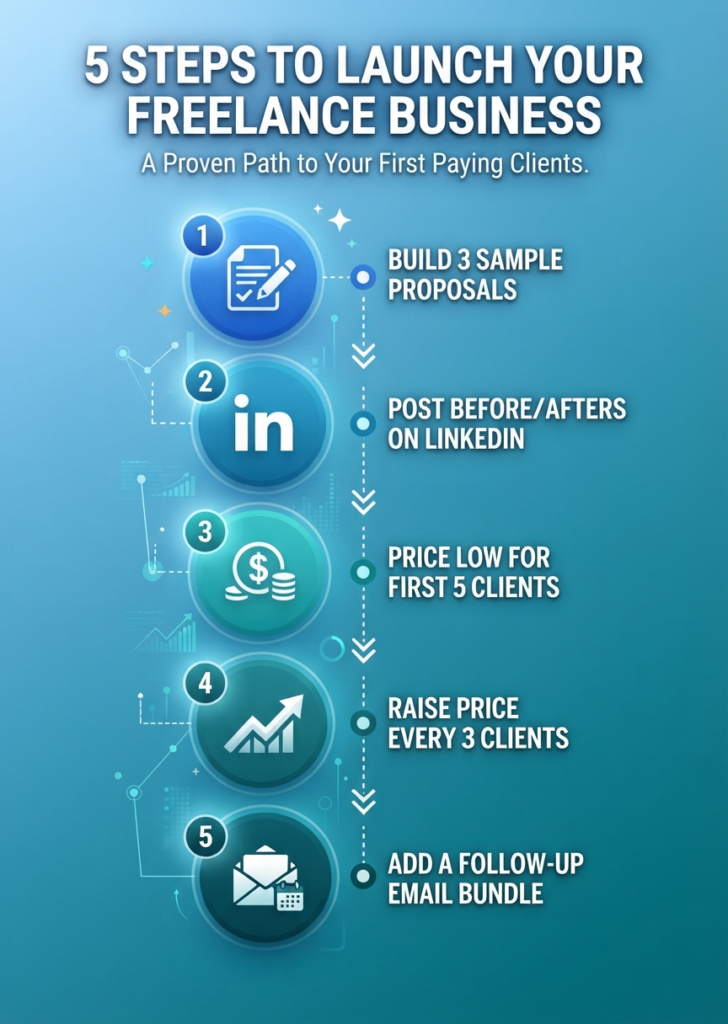
Step 1: I built three sample proposals for fake businesses.
I picked three niches — a landscaping company, a freelance photographer, and a small marketing agency. I wrote a full proposal for each using Claude, cleaned them up myself, and turned them into simple PDFs. This took one evening.
Step 2: I posted before-and-after examples on LinkedIn.
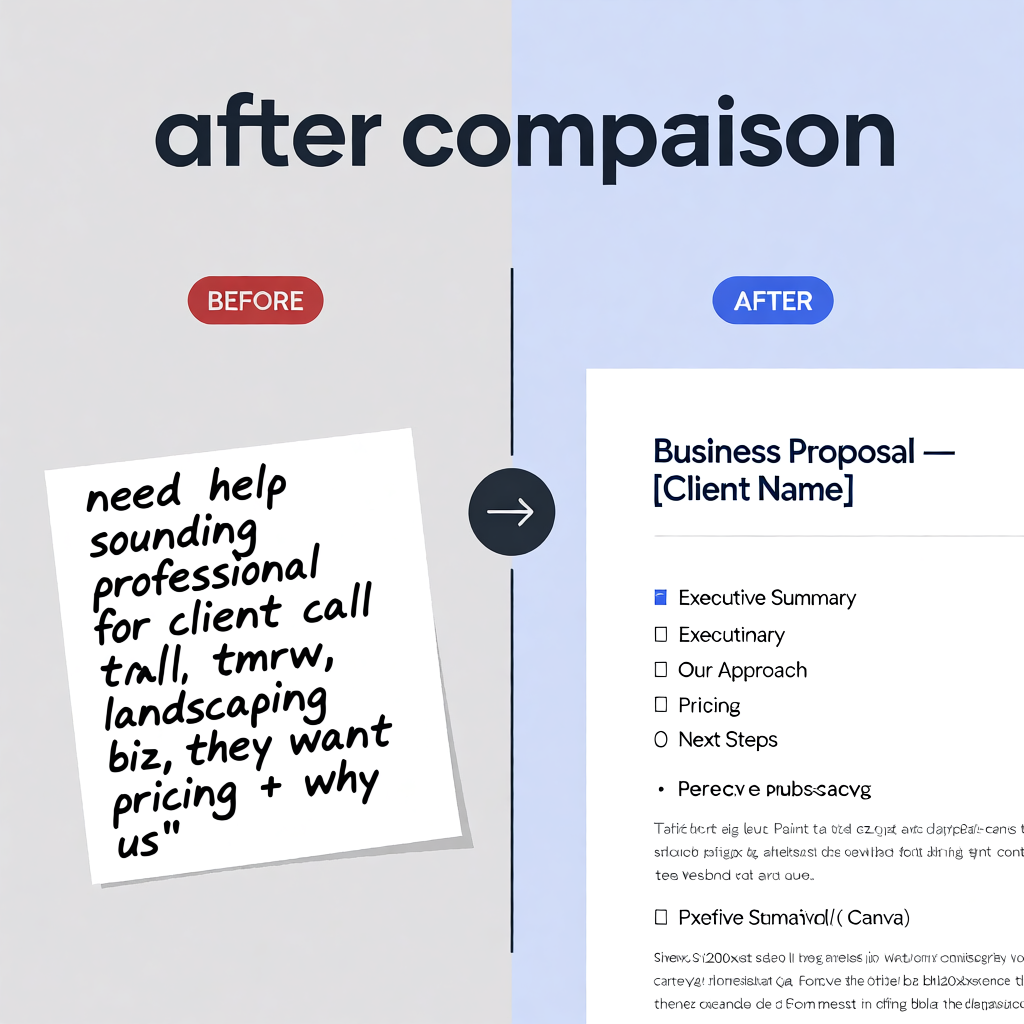
Not the AI process — nobody cares about that. I posted the client’s messy notes on one side and the finished proposal on the other. That contrast is what got attention, not any explanation of tools.
Step 3: I priced stupidly low for the first five clients.
My first proposal was $60. That felt almost embarrassing at the time, but it got me real feedback and my first testimonial, which mattered more than the money.
Step 4: I raised my price every three clients.
By client six I was charging $150 per proposal. By client twelve, $300. Nobody complained, because by then I had proof it worked.
Step 5: I started offering a “proposal + follow-up email” bundle.
This one small addition doubled my average order value almost overnight. Clients don’t just need the proposal — they need the awkward follow-up email too, and most of them hate writing that even more than the proposal itself.
The Tools I Actually Use
I keep this simple on purpose. Overcomplicating your toolkit is the fastest way to burn out on a side hustle.
- Claude for drafting the actual proposal structure and language, since it handles longer documents without losing context halfway through.
- Google Docs for client-facing editing and comments, because almost every client already knows how to use it.
- Canva for turning the final text into a designed PDF when a client wants something more visual than a plain document.
- Grammarly as a last-pass check, mostly to catch the small stuff I miss when I’ve read something four times.
That’s it. No expensive software, no complicated automation stack.
Mistakes That Cost Me Clients (So You Don’t Repeat Them)
I want to be honest here because most articles skip this part.
I once sent a proposal with the wrong company name in it. I had reused a template and forgot to change one instance of the previous client’s name. The client noticed immediately, and it made me look careless even though the actual content was solid. Now I do a manual find-and-replace check every single time before sending anything.
I made proposals sound too generic early on. My first few drafts read fine, but they could have applied to almost any business in that niche. Clients want to feel like the document was built specifically for them, not lightly reworded from a template. Now I always ask for at least one specific detail — a past project, a specific client pain point, a number — and build the proposal around that.
I underpriced revisions. I originally offered unlimited revisions at my base price. One client used that as an excuse to ask for eight rounds of changes. I now include two rounds in the base price and charge extra after that, clearly stated upfront.
Where to Actually Find Clients
This is the part people ask me about the most, so here’s exactly where my clients have come from.
- LinkedIn posts showing real before-and-after examples, not explanations of the process.
- Small business Facebook groups, particularly ones for freelancers, consultants, and agency owners who are constantly pitching new clients.
- Referrals from happy clients — every single client I’ve kept long-term has sent at least one referral.
- Fiverr and Upwork, though I’d treat these as a slower starting point rather than your main channel, since competition on price is intense there.
A Simple Pricing Structure You Can Copy
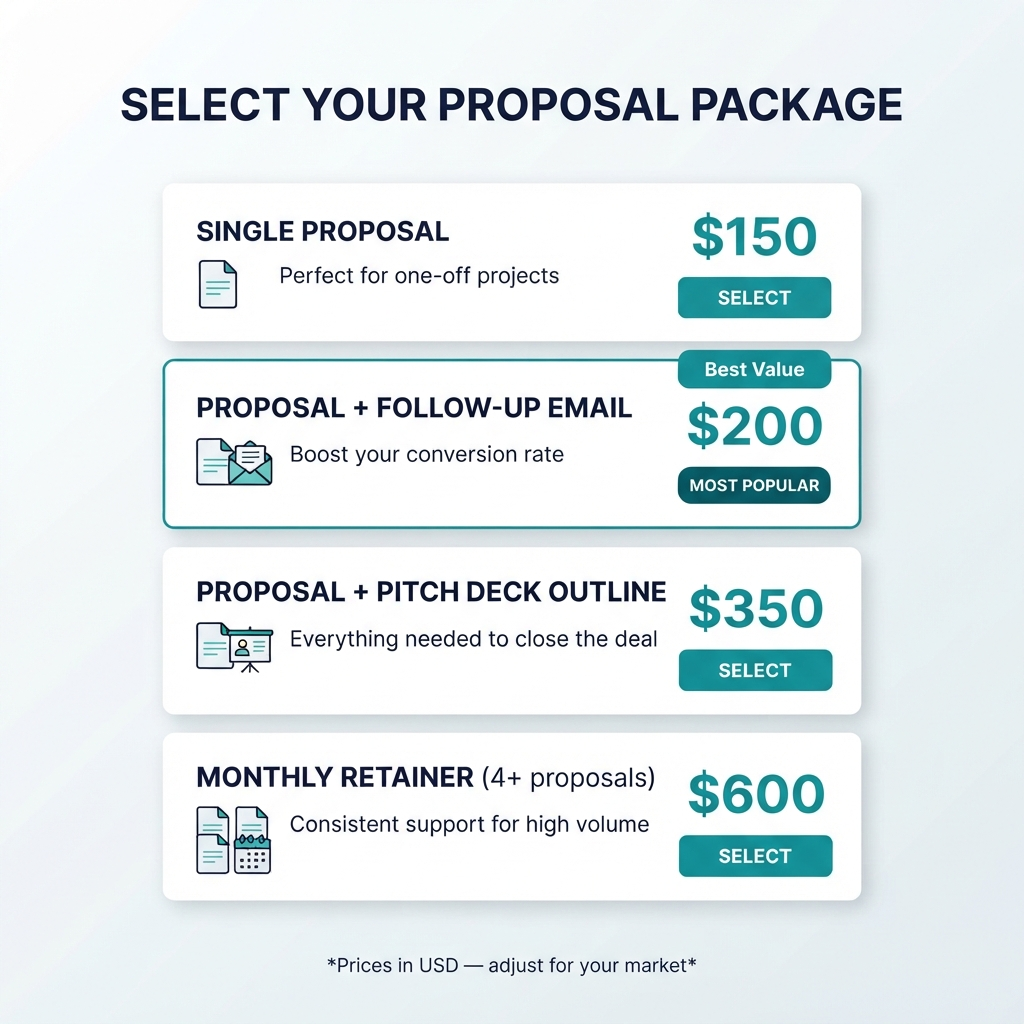
Here’s roughly what I use now, and you’re welcome to start from this:
- Single proposal (up to 3 pages): $150
- Proposal + follow-up email bundle: $200
- Proposal + pitch deck outline: $350
- Monthly retainer for agencies sending 4+ proposals per month: $600
Adjust based on your market. If you’re in the UK, expect slightly different phrasing in client requests — proposals are often called “pitches” or “tender documents,” especially for anything involving public sector or council work.
Real Example: A Consultant Proposal That Landed a $12,000 Contract
One of my clients, a marketing consultant, came to me with three paragraphs of rough notes about a potential retainer client. We turned that into a structured proposal with a clear scope, three pricing tiers, and a short case study section pulled from her past work.
She told me two weeks later the client signed the highest tier. That’s a $12,000 contract that started as three messy paragraphs in a text message to me.
That’s the actual value you’re offering here. It’s not the writing itself. It’s helping someone communicate their value clearly enough that a client says yes.
Common Mistakes to Avoid
- Don’t skip asking your client questions before you start writing. A five-minute voice note from them is worth more than guessing.
- Don’t hand over a document that still has AI-sounding phrases like “I hope this finds you well” scattered everywhere — clean those out.
- Don’t ignore formatting. A proposal that’s a wall of text feels harder to say yes to than one with clear headings and short sections.
- Don’t undercharge indefinitely. Your first few clients are for proof, not for building a permanent low price.
Frequently Asked Questions
Do I need writing experience to start an AI proposal writing service?
No. You need to understand what makes a proposal persuasive, which you can learn by studying a handful of good examples. The AI handles most of the heavy sentence-level work.
How much can I realistically charge as a beginner?
Most beginners start between $50 and $150 per proposal, then raise prices once they have two or three testimonials.
Is this considered ethical if I’m using AI to write it?
Yes, as long as you’re transparent that you use AI tools as part of your process and you personally review, edit, and take responsibility for the final document. Many agencies already do this internally.
What niches work best for this service?
Consultants, freelancers, small agencies, contractors, and coaches tend to need proposals most often, since they’re constantly pitching new clients one-on-one.
How long does it take to write one proposal?
Once you have a system, most proposals take 45 minutes to 90 minutes from client notes to finished document.
Final Thoughts
I didn’t set out to build a service around this. It started with one favor for a friend and turned into something that now brings in steady side income every month.
If you’re already comfortable using AI tools and you have a decent eye for what sounds convincing versus what sounds vague, this is one of the more realistic freelance services to start with almost no upfront cost. You don’t need a portfolio to begin — you need three good samples and the willingness to send that first LinkedIn post.
For more information, visit: APKSITE1



One Comment on “AI Proposal Writing Service: 7 Proven Ways I Turned It Into Real Freelance Income”