
My Wake-Up Moment With AI This Year
AI trends 2026 hit me differently when a colleague sent over a project brief last month — fully researched, structured, and formatted — and told me an AI agent did it in 11 minutes.
Not ChatGPT answering a question. An agent that opened tabs, pulled data, cross-referenced sources, and wrote the whole thing. Independently.
That was the moment I realized we’d crossed a line. AI isn’t a tool you prompt anymore. It’s becoming something you manage — like a junior colleague who never sleeps.
If you’ve been loosely following AI news and wondering what’s actually happening right now in the USA and Europe — not the hype, but the real shifts — this is what I’ve been tracking.
Trend 1 – Agentic AI: Your New Digital Coworker
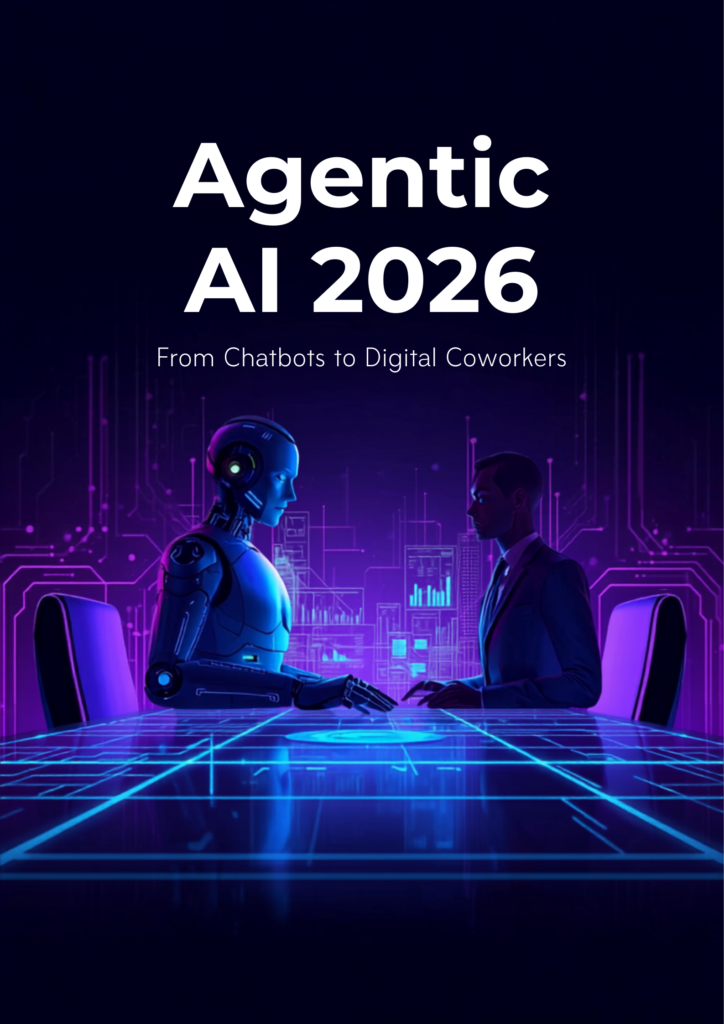
The biggest AI trend in 2026 isn’t a new model. It’s a new mode of working.
Agentic AI refers to systems that set their own sub-goals, make decisions, and complete multi-step tasks without you babysitting every step. You give it an objective; it figures out the path.
Google Cloud calls this the “agent leap” — where AI moves from answering prompts to running entire workflows end-to-end.
Gartner’s numbers back this up hard: 40% of enterprise apps will use task-specific AI agents by end of 2026, up from under 5% in 2025. That’s not a slow trend — that’s a cliff edge.
What does this look like in practice?
- A sales team in Chicago uses an AI agent to research prospects, draft outreach emails, and schedule follow-ups — automatically
- A London-based law firm runs agents that scan contracts for clause anomalies overnight
- E-commerce stores in Germany have agents monitoring competitor pricing and adjusting listings in real time
The catch? Agentic AI needs guardrails. Microsoft’s security team is now arguing that every AI agent should have the same identity and access management controls as a human employee. Because if an agent gets compromised, it can cause damage across your entire stack fast.
Trend 2 – The Best AI Tools Dominating 2026
If you search “best AI tools 2026” right now, you’ll get a flood of lists. But here’s what’s actually being used by real teams across the US, UK, Canada, and Australia:
ChatGPT (OpenAI) — Still the most visited AI platform in the world with over 5 billion monthly visits. It’s the default for most people.
Claude (Anthropic) — Quietly became the fastest-growing AI platform in 2026. Referral traffic is up nearly 4x this year. Better at long documents and nuanced reasoning.
Microsoft Copilot — Embedded inside Word, Excel, Teams, and Outlook. If your company uses Microsoft 365, you’re probably already using this without fully realizing it.
Google Gemini — Powers the AI Overviews you now see at the top of Google search results. Love them or hate them, they’re everywhere.
Perplexity AI — Growing fast as an AI-first search engine. Researchers and analysts especially love it. Think of it as Google but it actually cites its sources properly.
Each tool has a different sweet spot. I personally use Claude for writing and analysis, Perplexity for research, and Copilot when I’m deep in spreadsheets. Mixing them is the move.
Trend 3 – The US vs Europe AI Gap Nobody Talks About
Here’s a stat that surprised me when I first read it:
43% of US workers now use AI on the job. In Europe, that number is only 32%.
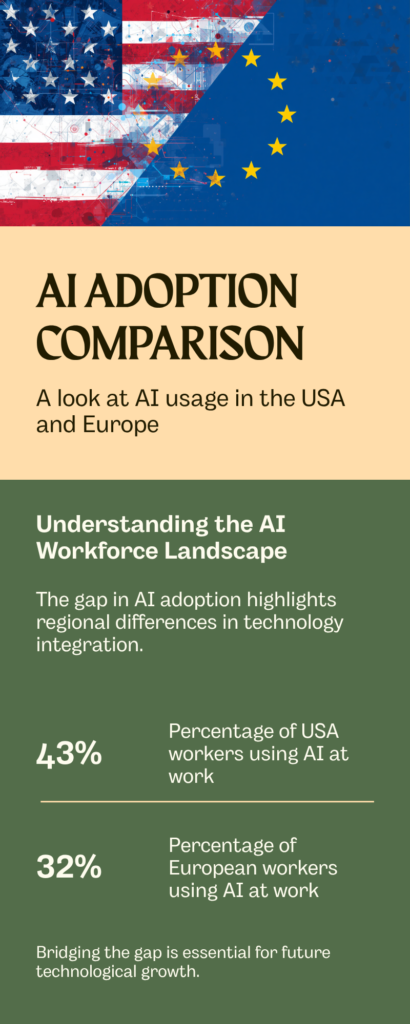
That 11-point gap, according to the Federal Reserve Bank of St. Louis, could translate to roughly 3.2 percentage points of extra cumulative productivity growth in the US vs Europe since 2022.
That’s not a small difference. That’s the kind of gap that compounds.
The US situation is a little complicated though. Despite leading in AI investment and model development, the average American worker ranks 21st globally in actual AI usage. The UAE, Singapore, and several Nordic countries use AI more actively per capita.
In Europe, public sentiment toward AI is actually improving fast — Germany +12%, France +10%, Netherlands +10% in positive AI perception year over year. The issue isn’t attitude. It’s adoption speed. European businesses are moving more cautiously, partly because of regulatory uncertainty (more on that next).
Trend 4 – The EU AI Act Is Now Real (And Has Teeth)
For years the EU AI Act felt like something governments were talking about. In 2026, it’s something businesses need to comply with.
A major enforcement phase kicks in August 2026, covering:
- High-risk AI systems (healthcare, law enforcement, education, credit scoring)
- Transparency rules for generative AI tools and chatbots
- A new ban on AI-generated non-consensual intimate imagery
- Clearer accountability rules for AI agents
This isn’t just a European problem. If your product touches EU users — even from the US or UK — these rules apply to you.
What I’m watching closely: the InvestAI initiative, where the EU is mobilizing €200 billion for AI infrastructure. A chunk of that — €20 billion — is going specifically to AI Gigafactories: massive computing facilities built to give Europe its own sovereign AI capability, independent of US or Chinese infrastructure.
The EU is essentially saying: we want to set the rules and build our own hardware to enforce them. That’s a significant long-term play.
Trend 5 – AI in Healthcare Is Saving Lives — and Causing Debates
AI in healthcare is one of the most searched topics of 2026, and for good reason. The real-world applications are no longer theoretical.
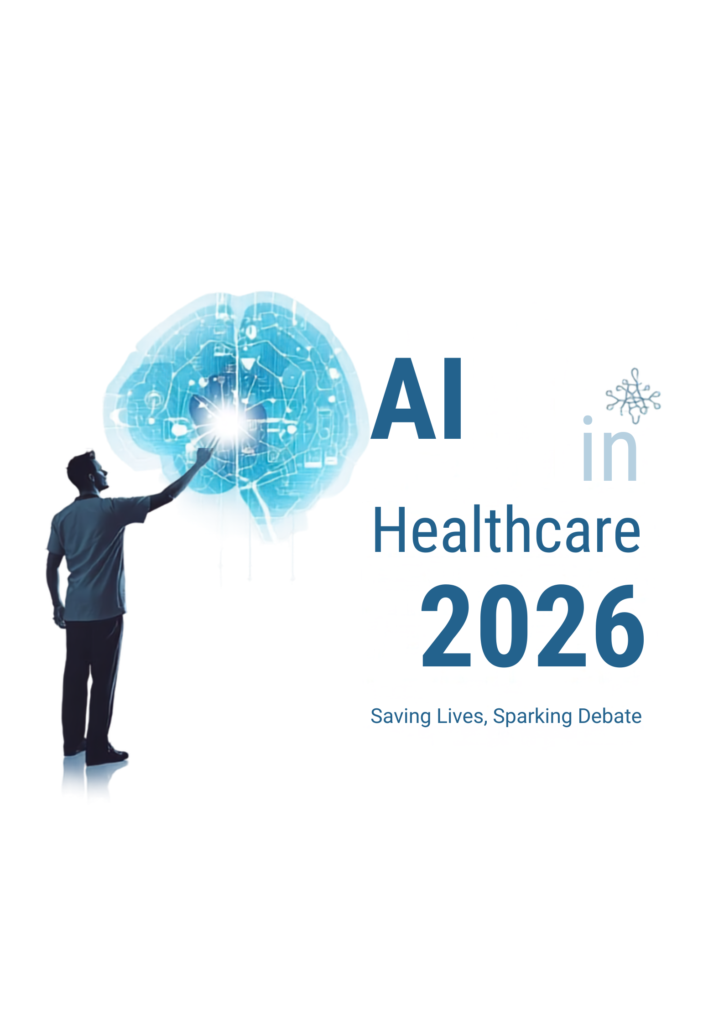
Right now, AI is being used for:
- Early cancer detection — AI imaging analysis catching tumors that radiologists miss on first pass
- Hospital resource planning — predictive models that tell hospital managers how many beds they’ll need three days from now
- Chronic disease management — virtual assistants reminding patients to take medication, flagging warning signs to doctors
The US and Europe are handling this very differently.
The US federal government has pushed toward deregulation — move fast, test in the market. Individual states are pushing back, mandating transparency disclosures and patient opt-outs for automated decisions.
Europe has healthcare AI categorized as high-risk under the EU AI Act, meaning strict pre-market testing, ongoing monitoring, and mandatory human oversight for critical decisions.
Neither approach is perfect. The US risks moving faster than safety evidence supports. Europe risks being so cautious that patients don’t get access to tools that could genuinely help them.
Trend 6 – AI and Jobs: Fear vs. What’s Actually Happening
Let me address the big question everyone’s googling: will AI replace jobs?
Here’s what the data actually says, not the headlines:
- 73% of AI experts believe AI will have a positive impact on how people do their jobs
- Only 23% of the general public agrees — a massive 50-point trust gap
- US software developer employment hit 2.2 million in early 2026 — up 8.5% year over year, a record high
- Over 80% of US high school and college students now use AI for schoolwork
What’s happening in practice: AI is compressing the time it takes to do existing work, not eliminating the work. Developers who use AI coding tools ship code faster. Writers who use AI draft faster. Analysts who use AI process data faster.
The people getting left behind aren’t the ones AI replaces — they’re the ones who refuse to learn how to work with it. That’s the uncomfortable but honest reality of this moment.
Trend 7 – AI Search Is Quietly Replacing Google for Millions
This one affects you directly if you run a website, publish content, or do any kind of digital marketing.
AI search is changing how people find information — fast.
- ChatGPT Search now processes 250–500 million search-intent queries every week
- 58.5% of all Google searches are now zero-click — users get the answer on the results page without visiting any site
- AI Overviews appear in essentially every informational search on Google
- Yet visitors arriving from AI platforms like ChatGPT convert at 14.2% vs Google’s 2.8% — roughly 5x more valuable per session
What this means for content creators: writing a generic 500-word post and hoping to rank is basically dead. AI systems cite content that is comprehensive, factually accurate, well-structured, and written with clear expertise.
The good news? This raises the floor, not just the ceiling. Better content wins more than it ever did before.
Mistakes People Are Making Right Now With AI
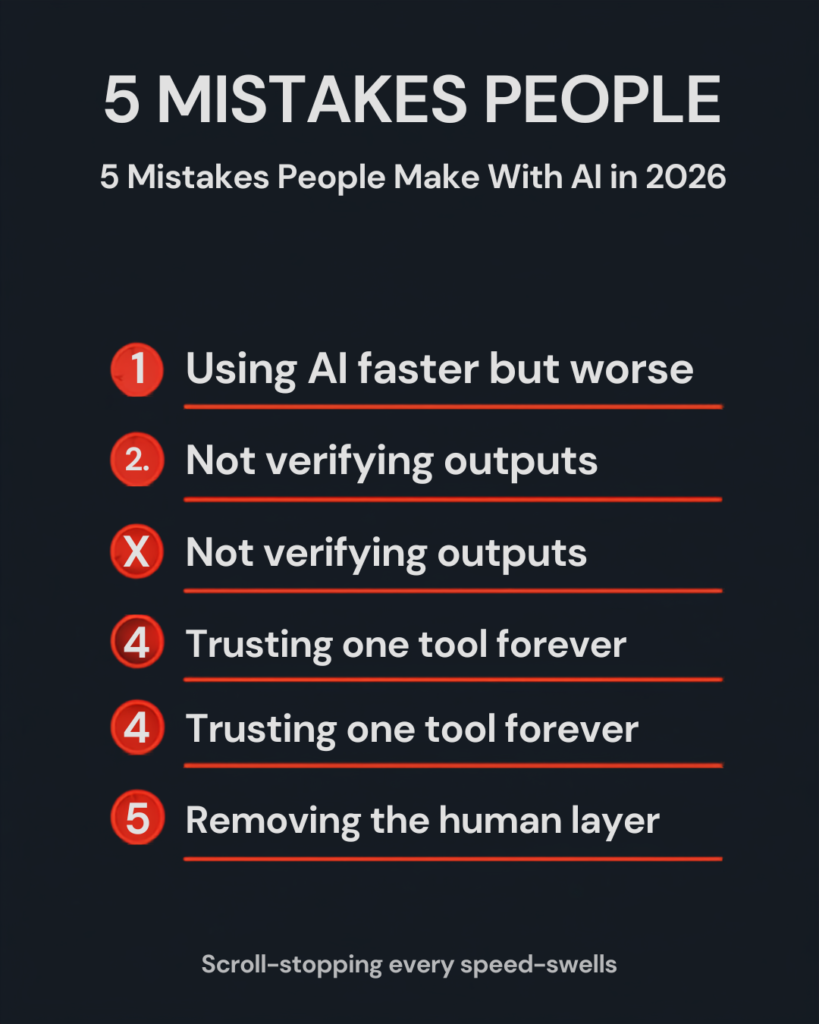
I’ve watched a lot of businesses and individuals fumble this transition. Here are the patterns I keep seeing:
Mistake 1: Using AI to do everything faster, but worse. AI can help you produce more. It can’t fix a strategy that was broken to begin with. People who use AI to scale up mediocre work just have more mediocre work.
Mistake 2: Not verifying AI outputs. AI tools still hallucinate. I’ve caught factual errors in AI-generated content that sounded completely confident. Always verify anything data-specific before you publish or act on it.
Mistake 3: Ignoring the regulatory side. If you’re building anything in Europe or serving EU customers, the EU AI Act isn’t optional. Many US-based startups are finding this out the hard way when they try to expand.
Mistake 4: Treating AI tools as permanent. The tool landscape is shifting so fast that something that’s best-in-class today might be mid-tier in six months. Build workflows around outcomes, not specific tools.
Mistake 5: Skipping the human layer. AI agents are powerful, but they need human judgment at key checkpoints. Fully autonomous AI pipelines with no human review are where things go wrong — in content, in business decisions, and especially in regulated industries.
Final Thoughts
AI trends in 2026 aren’t coming — they’re already here, and they’re moving faster than most of us expected.
The US is betting on speed and scale. Europe is betting on governance and sovereignty. Both approaches have merit, and honestly, both are going to learn from each other over the next few years.
What I know for sure: the people and businesses who treat AI as a genuine skill to develop — not just a button to press — are going to look back on this period as one of the biggest advantages they ever had.
The ones who wait until it “settles down”? There’s no settling down. This is the pace now.
Pick a tool, start using it seriously, and build from there. The learning curve is shorter than you think.
If you found this useful, share it with someone who’s still on the fence about AI. And bookmark this page — I update it as the landscape shifts.
For more information, visit: APKSITE1