

I used to think millionaires just got lucky — right place, right time, maybe a rich family behind them. Then I spent three years obsessively reading about wealth, interviewing business owners, and actually putting some of these strategies into practice myself. What I found completely changed how I think about money.
Here’s the honest truth: how millionaires make money is not some secret locked behind a private club. It’s a repeatable system. And once you understand the system, you stop chasing money and start building it.
Let me walk you through exactly what I learned — including the mistakes I made along the way.
Table of Contents
- The Two Types of Capital Every Millionaire Uses
- How Millionaires Make Money: The 50/20/30 Cash Flow Rule
- Active Investing — The High-Effort Path
- Passive Investing — The Quiet Wealth Builder
- Multiple Income Streams: The Real Secret
- Common Mistakes That Keep People Broke
- How to Start Building Wealth This Week
1. The Two Types of Capital Every Millionaire Uses {#capital}
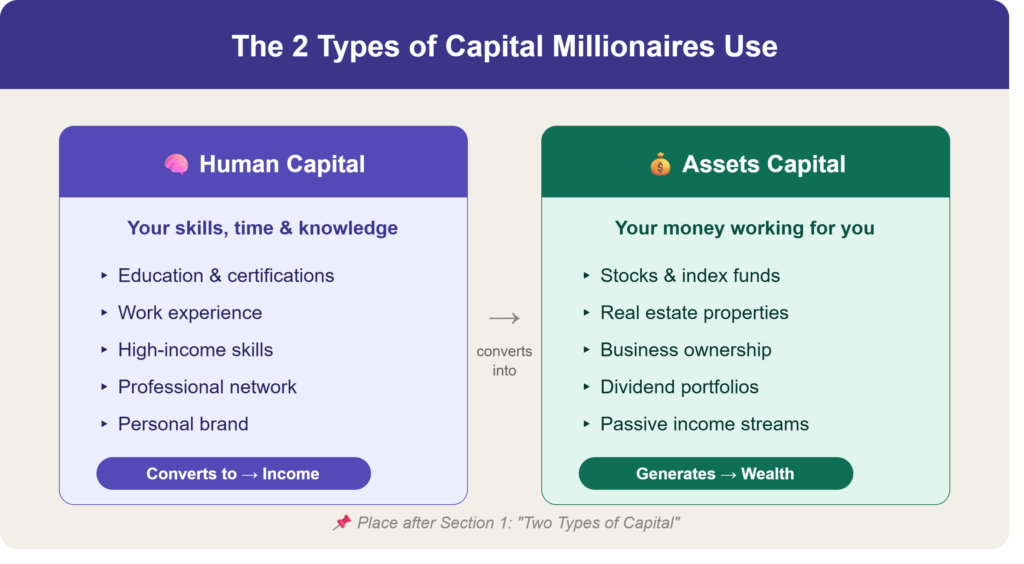
How millionaires make money starts with understanding capital — not in the textbook sense, but in the real-world sense.
There are two types:
Human Capital — This is you. Your skills, your expertise, your time, and your network. In the beginning, this is your only asset. A doctor earns high income because of high human capital. A skilled freelancer, a great salesperson, a sharp developer — all of them are monetizing human capital.
Assets Capital — This is what you build over time. Real estate, stocks, a business, investments. Assets capital makes money while you sleep. The goal of every millionaire is to convert human capital into assets capital as fast as possible.
Most people spend their entire lives only in the first category. They trade time for money, get a paycheck, spend it, and start again Monday. Millionaires do something different — they use their paycheck as raw material to build assets.
I made this mistake for years. I earned decent money in my late twenties, but I spent almost all of it. No assets, no growth. The moment I started deliberately moving money from income into investments — even small amounts — everything shifted.
2. How Millionaires Make Money: The 50/20/30 Cash Flow Rule {#cashflow}
One of the most eye-opening things I discovered is that millionaires are obsessive about cash flow management. Not budgeting in the painful “track every coffee” way — but in the systematic, automatic way.
The framework they follow, almost universally:
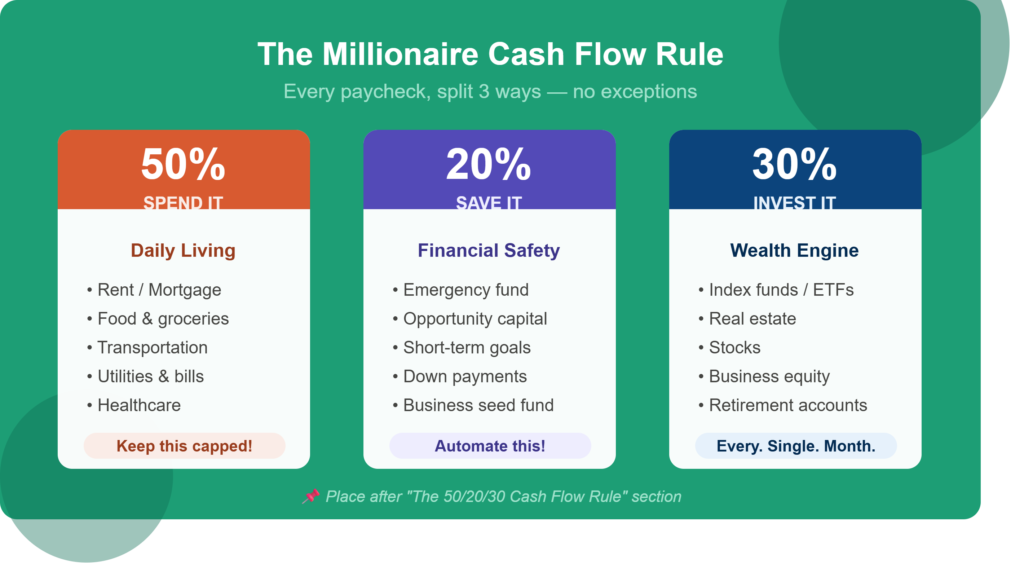
Spend 50% on Living Expenses Rent, food, utilities, transportation. Half your income, capped. Not 60%, not 70%. The wealthy live below their visible means — that’s why they look “normal” to outsiders but are building empires quietly.
Save 20% Non-Negotiably One fifth of every paycheck goes straight to savings — automatically, before you even see it. This isn’t your retirement fund. This is your opportunity capital. When a deal comes along, when the market dips, when a business opportunity shows up — you need cash ready to move.
Invest 30% Every Single Month This is the engine. Thirty percent, deployed into investments, every month without fail. Not when the market feels right. Not when you feel confident. Every. Single. Month.
I started with just 10% when I first tried this. Then pushed it to 20%. The habit matters more than the percentage at the beginning. Automate it. Forget it’s there. Check back in five years.
3. Active Investing — The High-Effort, High-Reward Path {#active}
When people ask how millionaires make money through investing, they usually picture someone glued to stock charts. That’s one version — but active investing is broader than that.
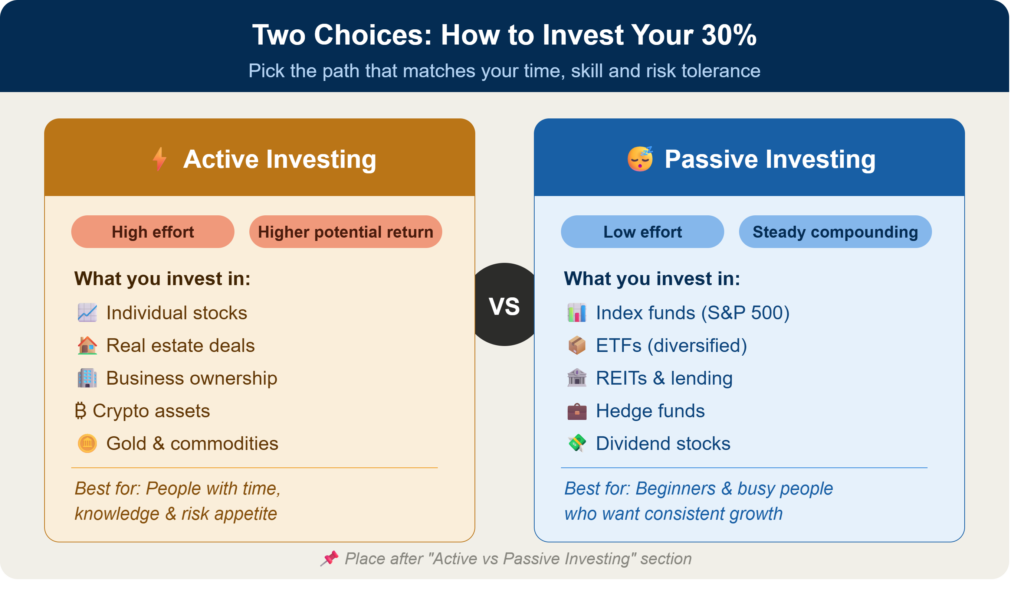
Stocks — Individual company shares. High potential, but requires research. Most millionaires who do this well spend serious time understanding the businesses they buy. They’re not gambling on ticker symbols.
Real Estate — Buying properties, renting them out, flipping them, or developing them. Real estate created more millionaires in America than almost any other asset class. The cash flow from rental income is consistent, and appreciation over time is historically strong.
Businesses — Either building one from scratch or acquiring an existing one. Many millionaires own small businesses that most people never hear about — a local chain, an online store, a service business. Boring and profitable beats exciting and broke every time.
Crypto and Gold — Higher volatility, higher risk. Some millionaires allocate a small percentage here as a speculative bet or inflation hedge. I wouldn’t put more than 5-10% of your portfolio here unless you genuinely understand what you’re buying.
The key rule with active investing: never invest in something you can’t explain in two sentences. If you can’t explain it, you can’t manage the risk.
4. Passive Investing — The Quiet Wealth Builder {#passive}
Here’s what most finance content doesn’t tell you loudly enough: the majority of millionaires use passive investing as their core wealth-building strategy. Not stock-picking, not real estate deals — just consistent, boring, automatic passive investments.
Index Funds — Funds that mirror a market index like the S&P 500. Warren Buffett famously recommended these for most regular investors. Low fees, broad diversification, and historically strong returns over long periods. This is where I put the bulk of my own investments.
ETFs (Exchange-Traded Funds) — Similar to index funds but traded like stocks throughout the day. More flexible, same general principle. Great for building a diversified portfolio without picking individual companies.
Hedge Funds — Available to high-net-worth investors. Professionally managed, complex strategies. Not accessible to most people starting out, but worth understanding as you scale.
Lending and REITs — Earning interest by lending money through platforms, or investing in real estate investment trusts that pay out rental income as dividends. Consistent passive income without the headache of managing properties yourself.
The data is clear on passive investing: over any 20-year period, a simple S&P 500 index fund outperforms the majority of actively managed funds. Boring wins. Patience wins.
5. Multiple Income Streams: The Real Secret Behind How Millionaires Make Money {#streams}
I saved this for later because most people jump straight here — and that’s actually the wrong order.
Studies consistently show that millionaires have an average of 3 to 7 income streams. But here’s what those studies don’t show clearly: most of those streams were built after the first one was stable.
The typical progression looks like this:
- Primary income — Job, business, freelancing. Strong and stable.
- Side income — A skill monetized separately, consulting, a small online business.
- Investment income — Dividends, rental income, interest.
- Passive digital income — A course, a book, affiliate commissions from a blog.
- Business ownership income — A stake in a business that operates without you.
You don’t build all of these at once. You build them one at a time, using each stream to fund the next.
I added my second income stream — freelance writing — while keeping my day job. That extra income went entirely into index funds for two years. Those investments then started generating small dividend payments. Three streams, built sequentially, not simultaneously.
6. Common Mistakes That Keep People From Building Wealth {#mistakes}
Since we’re being honest here, let me tell you what actually holds people back — because I’ve made most of these mistakes personally.
Lifestyle inflation — Every raise gets spent on a better car, a bigger apartment, nicer clothes. Your expenses grow as fast as your income. Millionaires resist this aggressively. They drive the same car for eight years. They live in the same house long after they could “afford” to upgrade.
Waiting for the “right time” to invest — The market is too high. The economy is uncertain. I’ll start when things settle down. This reasoning costs people hundreds of thousands of dollars over a lifetime. The best time to start investing was ten years ago. The second best time is today.
Treating savings as optional — Saving “whatever’s left over” at the end of the month means saving nothing. Pay yourself first. Automate your savings before you see the money. This single habit change is more powerful than any investment strategy.
Only having one income source — A single paycheck is a single point of failure. If that job disappears, everything disappears. Millionaires obsess over diversification — of investments and of income.
Chasing high-return shortcuts — Get-rich-quick schemes, hot stock tips, overnight crypto flips. I wasted money on two of these in my early twenties. The consistent boring path always wins over the exciting risky shortcut.
7. How to Start Building Wealth This Week {#start}
You don’t need to be earning six figures to start. You need to start with what you have.
This week, do these three things:
Step 1 — Audit your cash flow. Write down your income and where it goes. Be honest. You can’t fix what you can’t see.
Step 2 — Open an investment account. If you’re in the US, open a Roth IRA or a brokerage account on platforms like Fidelity, Schwab, or Vanguard. If you’re in Europe, look into ISAs (UK) or equivalent tax-advantaged accounts in your country. Fund it with whatever you can — even $50.
Step 3 — Set up automatic transfers. Decide your percentage — even 10% to start — and automate it. Every payday, money moves to your investment account before you can spend it.
That’s it. Three steps. Not glamorous, not exciting, but it’s the foundation of how millionaires make money — and how they keep making it.
Q: How do millionaires make money differently than average people?
A: Millionaires make money by building multiple income streams instead of relying on a single paycheck. They convert their human capital (skills and income) into assets capital (investments and businesses) as fast as possible. While average people trade time for money, millionaires build systems — like rental properties, dividend portfolios, and index funds — that generate income without their daily involvement. The key difference is not how much they earn, but how strategically they deploy what they earn.
Q: What percentage of income should I invest to become a millionaire?
A: Financial experts and millionaires consistently recommend investing a minimum of 30% of your income every single month. Combined with the 50/20/30 rule — spending 50% on living expenses and saving 20% — this disciplined approach allows your money to compound significantly over time. For example, investing $1,000 per month at an average 8% annual return over 30 years grows to over $1.4 million. The percentage matters less than the consistency.
Q: Is passive investing better than active investing for building wealth?
A: For most people, passive investing consistently outperforms active investing over the long term. Studies show that over any 20-year period, a simple S&P 500 index fund beats the majority of actively managed funds after fees. Passive investing through index funds and ETFs requires less time, lower fees, and less emotional decision-making. Active investing in stocks, real estate, or businesses can deliver higher returns but demands deep knowledge, time, and risk tolerance. Most millionaires use a combination of both.
Q: How many income streams do millionaires typically have?
A: Research shows that millionaires have an average of 3 to 7 income streams. These typically include a primary income source such as a job or business, investment income from dividends or rental properties, a side business or freelance income, and passive digital income from courses or affiliate marketing. Importantly, millionaires do not build all streams at once — they build one stable stream first, then use its profits to fund the next. Diversification of income is their biggest protection against financial setbacks.
The gap between people who build wealth and people who don’t usually isn’t income. It isn’t intelligence. It isn’t luck. It’s whether they understand the system and actually commit to following it.
You now understand the system. The rest is just showing up consistently.
Have questions about getting started with investing? Drop them in the comments below — I read every one.
For more information, visit: APKSITE1