
I still remember the night I almost gave up on my AI content creation side hustle. It was past midnight, I had four client briefs open in different tabs, ChatGPT was giving me the same generic paragraph for the third time, and I genuinely thought — this is not going to work, is it.
Fast forward eight months, and that same messy setup is now bringing in a steady chunk of my monthly income. Not “quit your job tomorrow” money, but real, consistent money that I earn from my laptop while wearing pajama bottoms and questionable socks.
If you’ve been scrolling through videos promising you can make $500 a day just by “prompting AI,” I want to give you the version nobody posts — the slow, occasionally frustrating, but genuinely doable version.
What an AI Content Creation Side Hustle Actually Looks Like
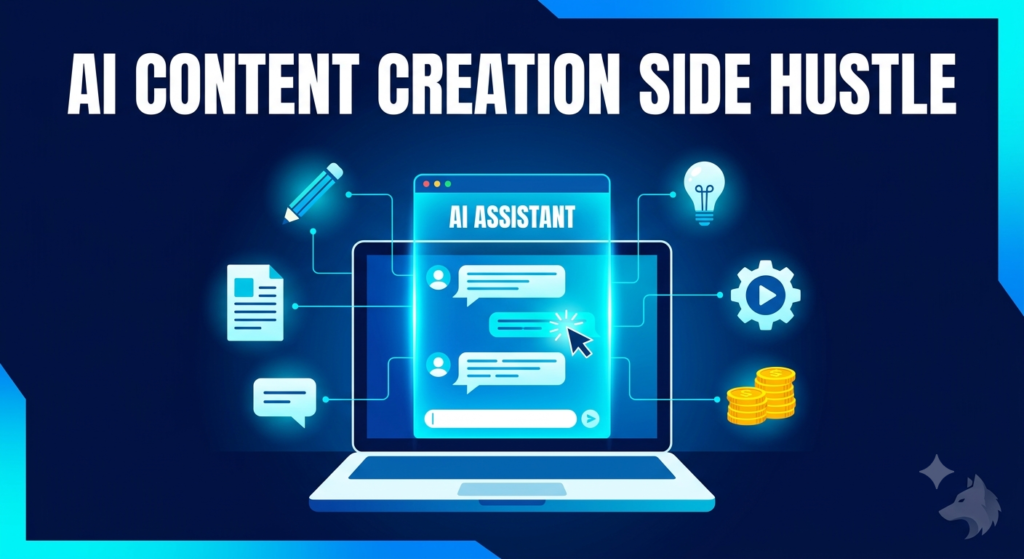
Let’s get one thing straight first. An AI content creation side hustle isn’t about typing one sentence into a chatbot and copy-pasting the output for cash. That’s the fantasy version people sell in course funnels.
The real version looks more like this: you use AI tools to speed up writing, editing, image generation, or video scripting — and then you add the human judgment, editing, and taste that clients are actually paying for. AI does the heavy lifting. You do the thinking.
When I started, I was writing blog posts for a couple of small businesses. Nothing fancy — a plumbing company, a local bakery, a fitness coach. My old process was: research for an hour, write for two hours, edit for another hour. Four hours per 1,000-word article, if I was lucky.
Once I actually learned how to use AI tools properly (not just “write me a blog post about X”), that same article started taking me about 90 minutes, start to finish. That extra time is where the money comes from — you can take on more clients without burning out.
How I Actually Got Started (Including the Embarrassing First Attempt)
My first attempt was rough. I signed up on Fiverr, slapped together a gig called “I will write SEO blog posts fast,” and waited for clients to roll in.
Nobody came. For three weeks.
Turns out “fast” isn’t a selling point when everyone assumes fast means AI-generated garbage. Clients are scared of exactly that — thin, robotic content that Google might penalize and readers will bounce from immediately.
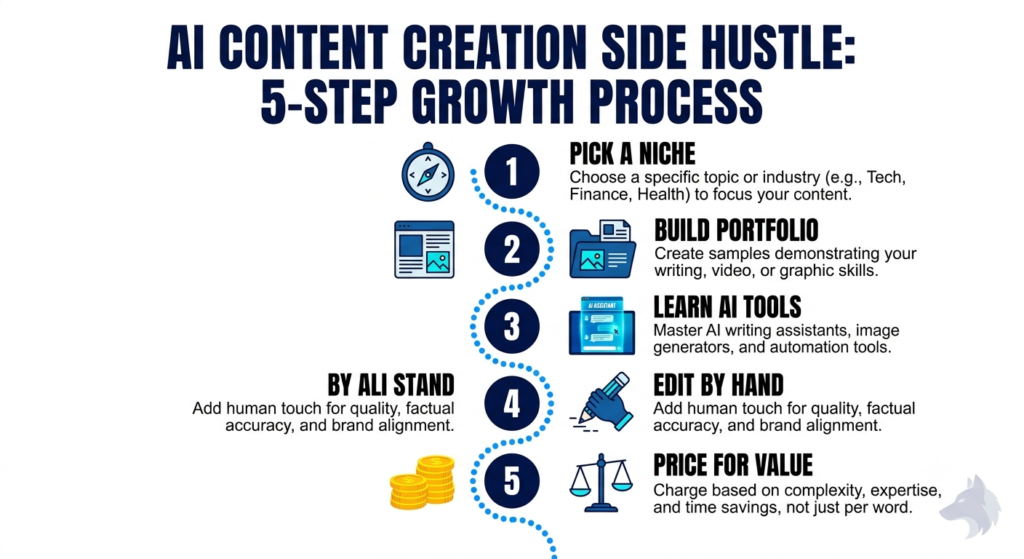
So I changed my whole approach. Here’s the step-by-step version of what actually worked:
Step 1: Pick one narrow service, not five vague ones
Instead of “I do everything AI-related,” I picked one thing: AI-assisted blog writing for small local businesses. That’s it. Specific enough that people searching for it found me easily.
Step 2: Build a small portfolio using your own blog
Before I ever pitched a client, I wrote three articles for my own site using my AI-assisted process. That became my proof. When someone asked “can I see examples,” I had something real to show, not just claims.
Step 3: Learn your tools properly
I use a mix of ChatGPT and Claude for drafting and structuring, Grammarly for cleanup, and Canva for any accompanying graphics. The trick isn’t which tool you use — it’s how you prompt it. Vague prompts give vague content. Specific prompts (target audience, tone, real examples, actual data points) give something usable.
Step 4: Always add a human editing pass
This is the step most people skip, and it’s the one that matters most. I read every single output out loud before publishing. If it sounds like a robot wrote it, or repeats itself, or makes a claim I can’t back up, I fix it. This one habit alone is what separates a real AI content creation side hustle from a content mill nobody trusts.
Step 5: Price for your time saved, not for “AI cheapness”
My biggest early mistake was undercharging because I felt guilty using AI. I charged $15 for a 1,000-word article because it “only” took 90 minutes. That’s insulting to your own skill. Clients aren’t paying for typing speed — they’re paying for a finished, edited, on-brand piece of content that solves their problem. I now charge closer to what a skilled human writer charges, because that’s essentially what I still am.
Real Numbers (No Fluff)
In my first two months, I made around $180 total. Genuinely not impressive.
By month five, after refining my process and raising my rates, I was averaging around $900 a month from three recurring clients, working roughly 10-12 hours a week.
By month eight, one client turned into a monthly retainer worth $600 alone, just for four blog posts a month. That’s the real shape of this side hustle — it starts slow, and it compounds once you have repeat clients instead of one-off gigs.
Where the Actual Money Comes From
There isn’t just one way to run an AI content creation side hustle. Here are the paths I’ve either used myself or watched other people succeed with:
- Blog writing for small businesses — my main income source, using AI for drafting and structure, then heavy human editing.
- Social media captions and content calendars — quick to produce, in constant demand, especially for small brands without a marketing team.
- Freelance SEO content on Upwork and Fiverr — more competitive, but higher volume of potential clients.
- AI-assisted video scripts for YouTubers and TikTok creators who need scripts fast but still want their own voice.
- Selling digital templates — prompt packs, content calendars, and outline templates built partly with AI, sold on Gumroad or Etsy.
I’ve personally only done the first three seriously. The last two are things I’ve watched friends do successfully, and they follow the same core rule: AI speeds up the boring parts, you handle the parts that need actual judgment.
Mistakes I’d Tell My Past Self to Avoid
Mistake 1: Publishing the first draft. Early on, I sent a client an article that had an AI-generated statistic that turned out to be completely made up. Mortifying. Now I fact-check every number and claim before it goes anywhere near a client.
Mistake 2: Ignoring the client’s actual voice. My bakery client sounded like a corporate consultant in my first drafts because I didn’t bother learning her tone. Now I always ask for three examples of content they liked before writing anything.
Mistake 3: Not disclosing AI use when it mattered. Some clients genuinely don’t mind AI assistance, some do. I learned to just be upfront about my process. It builds trust instead of risking an awkward conversation later.
Mistake 4: Chasing every AI tool that went viral. I wasted actual money subscribing to three different “AI writing suites” that all did roughly the same thing. Pick one or two solid tools and get good at them instead of tool-hopping.
Is This Side Hustle Actually Worth Starting?
Honestly? Yes, but with a realistic mindset. This isn’t a passive income dream where money appears while you sleep. It’s a service business that happens to be faster and more scalable because of AI. You still need to find clients, communicate well, and deliver quality work.
If you already have some writing, editing, or communication skills, an AI content creation side hustle is one of the more realistic ways to build extra income right now, especially compared to things like dropshipping or crypto trading, where the learning curve and risk are both much higher.
If you’re curious about other realistic AI-powered income options, our guide on AI side hustles for 2026 breaks down a few more paths worth considering.
A Few Tools Worth Checking Out
If you want to try this yourself, these are the tools I’ve actually used, not just heard about:
- ChatGPT for drafting and outlining
- Grammarly for the final polish pass
- Canva for any graphics that go alongside your content
- Fiverr and Upwork for actually finding clients
Final Thoughts
I won’t pretend this side hustle turned me into some overnight success story. It didn’t. It took months of adjusting, a few awkward client conversations, and one genuinely embarrassing mistake with a made-up statistic.
But it’s real, it’s repeatable, and it’s one of the few side hustles right now where the tools are actually catching up to the hype instead of the other way around. If you’re willing to put in the editing hours AI can’t do for you, there’s genuine money here.
For more information, visit: APKSITE1